
01 / FundamentalsTwo things to assess in an opening hand
1. Prioritize hand development
With your first five cards, consider which hands you can build with future draws. Keep combinations that leave room for your rows to develop.
Suppose you are OOP (placing first) and receive Q♠, 7♦, 4♦, 3♣, and A♥. Putting Q♠ and 7♦ together on the bottom rules out both a straight and a flush in that row.
Instead, put 3, 4, and 7 in the middle and Q on the bottom. The bottom retains the potential for a straight or better, and the middle can still develop into a straight.
This is the idea behind hand development: leave room for future cards to build complete hands.
Five dealt cards
Putting Q and 7 on the bottom
Together, Q♠ and 7♦ can make neither a straight nor a flush.
Splitting them between middle and bottom
Both the middle and bottom retain potential.
The middle can make a straight; the bottom can still make a straight or better.
2. Consider entry rate and value after entry
When aiming for Fantasyland, consider both your chance of entering and the value of the FL hand that follows.
Regular: prioritize avoiding fouls.
A foul is costly, so preserve a workable structure across all three rows rather than forcing a strong top hand.
Alongside QQ FL, consider earning royalties with top-row TT or JJ.
Every FL deal contains 14 cards; the top-row royalties differ.
Joker Ultimate: consider taking some risk to aim for AA FL or Trips FL.
The entry hand determines the FL deal size, which is retained when FL continues.
Compare placements that pursue valuable FL entries as well as those that avoid fouls.
FL means Fantasyland. QQ FL, KK FL, and AA FL refer to entry with those top-row pairs. Trips FL means entering with top-row trips.
In every variant, you must finish the lower two rows while pursuing the top row.
In Regular, avoid fouls while pursuing FL and royalties.
In Joker Ultimate, also consider the value of AA FL and Trips FL.
02 / Placement catalogStart with the shape closest to your deal
Start with these six patterns.
Condition: every example is an OOP opening hand (you place first). Each diagram is a solver-verified recommended placement under this condition. For IP (placing after seeing the opponent’s placement), recommendations change with the opponent cards you can see.
PATTERN 01one pair
Five dealt cards
PATTERN 02two pair
Five dealt cards
Regular
Split the pairs and aim for QQ FL on top.
Joker Ultimate
Aim for a bottom full house and middle trips or better, building a foundation for royalties and AA FL or Trips FL.
PATTERN 03Three suited cards
Five dealt cards
Regular
Aim for a bottom flush and QQ FL.
Joker Ultimate
Aim for a bottom flush and KK FL.
PATTERN 04Four suited cards
Five dealt cards
Regular
Pursue a flush, using A as the middle-row anchor.
Joker Ultimate
Aim for a bottom flush and use the A on top to pursue AA FL.
PATTERN 05trips
Five dealt cards
Regular
Use bottom-row trips as a foundation for KK FL.
Joker Ultimate
Use bottom-row trips as a foundation for AA FL.
PATTERN 06No pair or suited group
Five dealt cards
Regular
Keep A in the middle and use the K on top to aim for KK FL.
Joker Ultimate
Keep K on the bottom and use the A on top to aim for AA FL.
03 / ReviewRecord uncertain spots and compare them in analysis
When a placement feels uncertain, record the five cards dealt, the game type, and your placement. If you were IP, also record the opponent cards that were visible then.
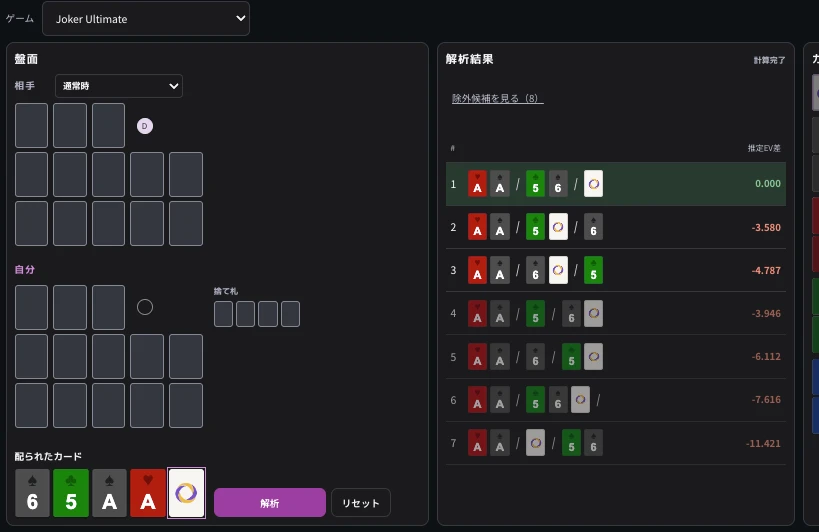
After the game, recreate the spot and compare placement candidates and EV differences. See how hand development and FL aims differ from your own idea and use that insight in your next decision.
compare an uncertain opening hand.
Review your placements after play with OFC Oracle.
Frequently asked questions
Should I prioritize FL entry rate alone?
Alongside FL entry rate, points earned in normal hands also matter. Consider normal-hand scoring, foul risk, and the value after entering FL rather than focusing on entry alone.
Should suited cards always stay together?
Not always.
The decision also changes between OOP and IP.
Every example in this article is OOP.
When IP, you can see opponent cards, so account for whether cards needed for a suit or hand are already in use.
Are the diagrams solver recommendations?
Yes.
The six shown patterns are solver-verified recommended placements when you are OOP.
They assume the deal and rules shown in each diagram; IP recommendations change with visible opponent cards.