
01 / Core rulesWhat is OFC?
OFC (Open-Face Chinese Poker) is a poker game in which you arrange cards across top, middle, and bottom rows, then compare each row with your opponent’s.
In Japan, the game is also known as “Chaipo.”
02 / Core rulesSplit 13 cards into 3, 5, and 5
Make high card, one pair, or trips.
Make a hand at least as strong as the top row.
Make the strongest of the three hands.
Within the same hand category, compare card ranks. For example, a KK pair beats QQ. The top row has three cards, so it cannot be a straight or flush.
Completed example: correct hand order
Top QQ → middle two pair, KK and 88 → bottom flush. The hands get stronger as you move down.
03 / Core rulesHow one hand unfolds
Place all five cards in any rows you choose. Do not discard here.
Draw three cards and place two. Discard the remaining card face down.
Repeat “choose 2 from 3” four times to complete all 13 cards.
Once placed, a card cannot move to another row. Leave room for later cards as well as the hand you have now.
It also matters whether you place first or second
The player placing first is OOP; the player placing after seeing the opponent’s placement is IP.
IP can use the opponent cards visible at that moment in the decision.
You cannot see opponent discards or cards not yet drawn.
04 / Core rulesA foul breaks the required hand order
If the top is stronger than the middle, or the middle is stronger than the bottom, the board fouls. Even a strong hand does not score when the three-row order is broken.
Foul example: top KK > middle QQ
Even with a bottom flush, this fouls because middle QQ does not support top KK.
If you make a high top pair to pursue FL, the middle and bottom must also finish stronger.
If only you foul, the comparison is treated as losing all three rows and being scooped, and you receive no royalties.
A qualifying top hand does not enter FL if the board fouls.
05 / Core rulesScoring is row results plus hand bonuses
When boards are complete, compare like rows: top with top, middle with middle, bottom with bottom.
Win +1 point, lose −1 point; a tied row is 0.
The regular 3 points plus a 3-point scoop bonus make +6.
Add your royalties and subtract the opponent’s.
Example: compare these two scores
A Regular settlement example against one opponent. Both boards are complete and non-fouled.
you
QQ pair | 7 royalty points
KK and 88 two pair | 0 points
Flush | 4 points
Total royalties: 11 points
opponent
JJ pair | 6 royalty points
TT and 77 two pair | 0 points
Straight | 2 points
Total royalties: 8 points
| Comparison | you | opponent |
|---|---|---|
| Top: QQ > JJ | +1 point | −1 point |
| Middle: KK and 88 > TT and 77 | +1 point | −1 point |
| Bottom: flush > straight | +1 point | −1 point |
| Scoop: win all 3 rows | +3 points | −3 points |
| Royalty difference | 11 − 8 = +3 points | 8 − 11 = −3 points |
| Final score | +9 points | −9 points |
Your score is 3 row-result points + 3 scoop points + 3 royalty-difference points = +9.
Because opponent royalties are subtracted, you do not simply add your 11 points.
What if you win two rows and lose one?
The row result is +1 +1 −1 = +1 point. Then add the royalty difference between you and the opponent. Winning two rows does not earn a scoop.
Royalties are bonuses determined by the hand and row.
They apply to top-row pairs of 66 or higher and trips, middle-row trips or better, and bottom-row straights or better.
Top-row TT and JJ pairs earn royalties even though they do not enter FL.
Royalties by hand are listed in the Scoring and FL reference.
06 / Core rulesGame types
OFC variants include Regular, Progressive, and Joker Ultimate.
They share the three-row layout and normal-hand sequence. Jokers and Fantasyland (FL) deal sizes differ.
Uses 52 cards without jokers. FL deals 14 cards regardless of the top hand, including on continuation.
Uses 52 cards without jokers. Entry FL deals 14–17 cards according to the top hand; continuation returns to 14.
Uses 54 cards including two jokers. Entry FL deals 14–17 cards, and continuation retains the entry deal size.
In Joker Ultimate, jokers are wild cards: they can represent other cards to complete a hand. Their presence changes both hand-building possibilities and placement decisions.
The next section covers FL entry requirements and deal sizes by game.
07 / Core rulesWhat is Fantasyland (FL)?
In a normal hand, make a pair of QQ or higher, or trips, on top and finish without fouling to enter FL on the next hand.
In FL, receive the cards all at once and place all 13 cards together.
You can build while seeing the whole deal instead of drawing gradually; discard unused cards.
Your FL placement remains hidden from the opponent and is revealed at the end of the hand.
When you are in FL and the opponent is in a normal hand, you can see the opponent’s exposed cards.
This article calls FL by its qualifying top hand: QQ FL / KK FL / AA FL / Trips FL.
FL deal size depends on the game and top hand
| Qualifying top hand | Regular | Progressive | Joker Ultimate |
|---|---|---|---|
| QQ FL | 14 cards | 14 cards | 14 cards |
| KK FL | 14 cards | 15 cards | 15 cards |
| AA FL | 14 cards | 16 cards | 16 cards |
| Trips FL | 14 cards | 17 cards | 17 cards |
Regular always deals 14 cards in FL.
In Progressive and Joker Ultimate, QQ FL deals 14 cards, KK FL 15, AA FL 16, and Trips FL 17.
For example, in Joker Ultimate, AA FL gives you 16 cards: place 13 and discard 3.
With Trips FL, place 13 of the 17 cards and discard 4.
Whatever the deal size, the completed board contains 3 cards on top, 5 in the middle, and 5 on the bottom.
How do you continue FL?
In all three variants, while in FL, make top trips or bottom quads or better and finish without fouling to remain in FL next hand.
Unlike entering from a normal hand, top QQ alone does not continue FL.
On continuation, Regular and Progressive deal 14 cards. Joker Ultimate retains the entry deal size: an AA FL entry continues with 16 cards.
Once you know the rules, move on to opening placements
Next, see how to split a real five-card deal. Compare six deals—including one pair, two pair, and suited cards—in Regular and Joker Ultimate placement diagrams.
see how to place the first five cards.
Learn placement ideas from six deals.
- Regular
- Progressive
- Joker Ultimate
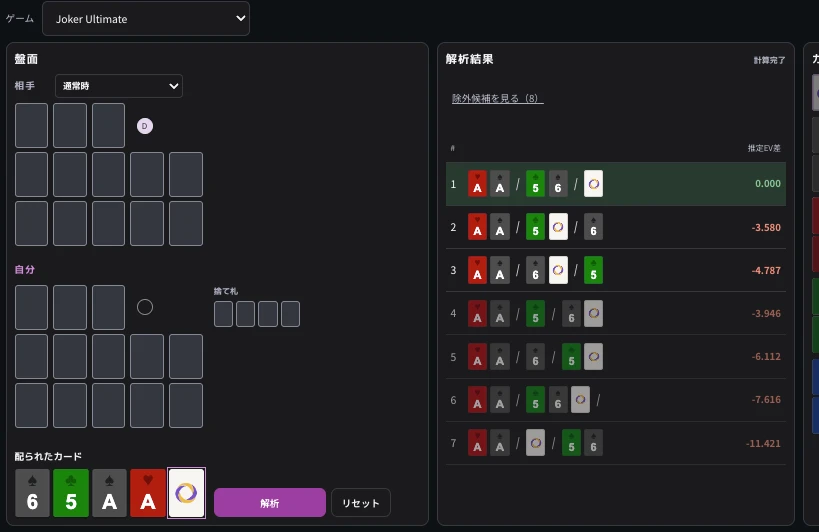
Try your own placement in the free analyzer
For learning and post-game review
Frequently asked questions
Can the three-card top row make a flush?
No. The top row is evaluated only as high card, one pair, or trips.
Can I discard one of the first five cards?
Place all of the first five cards. You start discarding one card from later three-card draws.
Does top QQ always enter FL?
The middle and bottom must be complete and the board cannot foul. Placing QQ alone does not guarantee entry.
Can I move a placed card later?
Placed cards cannot move. Place them with later draws in mind.